.webp)

The Trust-First Fintech Branding Playbook: 7 Essentials for User Acquisition

The Trust-First Fintech Branding Playbook: 7 Essentials for User Acquisition

Fintech acquisition costs are skyrocketing; $400+ per user in competitive verticals. Users swipe past flashy ads but pause for brands that scream "safe." Trust-first branding isn't defensive, it's your most efficient acquisition channel.
Here's the 7-part playbook that turns skeptics into deposits.
What Makes Trust-First Branding an Acquisition Weapon?

Trust-first branding prioritizes psychological safety across every pixel, copy, and interaction. In fintech, where users fear losing money > gaining yield, this approach crushes traditional "growth hacks."
Why it accelerates acquisition:
- Reduces funnel drop-off 40-60% (no more KYC abandonment)
- Organic share rate 3-5x higher (users recommend brands they trust)
- Paid CAC drops 25-35% (higher CR = lower cost per conversion)
- LTV compounds (trusted users deposit more, withdraw less)
Traditional fintech branding sells excitement. Trust-first branding sells certainty.
Why Trust-First Wins User Acquisition

1. B2B decision-makers have compliance homework
CFOs don't choose based on 30-second ads. They need board-ready screenshots showing SOC2 badges, encryption standards, audit trails.
2. Consumers need instant reassurance
Before linking a bank account, users scan for: lock icons, regulator mentions, human support options. Miss these signals? They bounce.
3. Referrals only flow from conviction
Users share Venmo screenshots, not Chime ads. Trust creates the "I use this and it's safe" social proof.
4. Regulatory moats compound
MiFID II, SOC2, GDPR compliance; displayed confidently, block weaker competitors overnight.
The 7 Trust-First Essentials (Rewritten for Clarity)
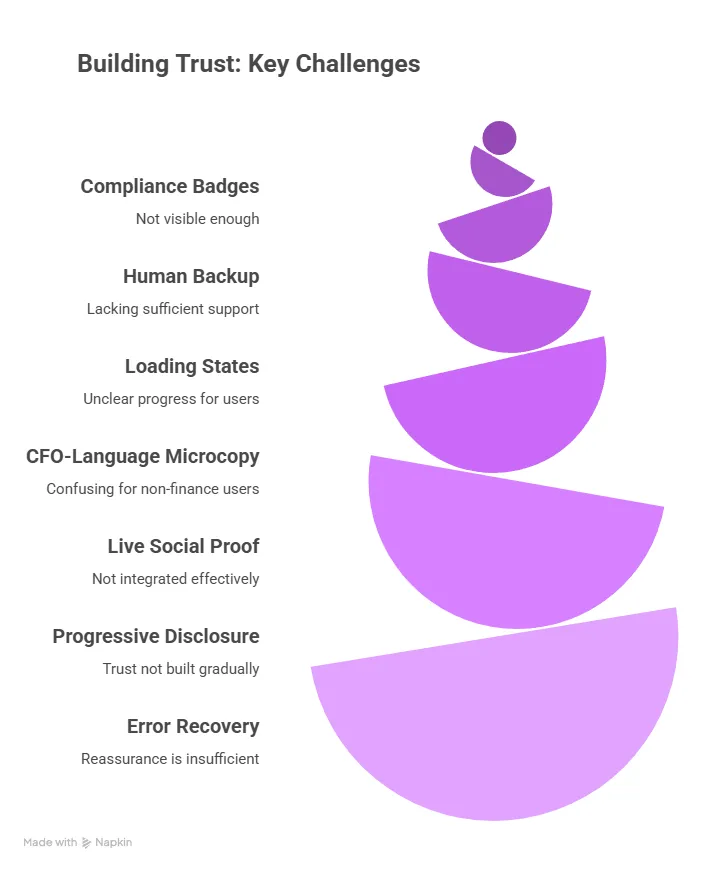
Here are the 7 specific, implementable design patterns that turn fintech landing pages from "sketchy startup" to "I'd trust with company funds." Each includes the exact copy, placement, and expected lift.
Essential 1: Compliance Badges Above the Fold
Problem: Users need instant proof you're regulated before they scroll.
Fix: Pin 2-3 badges to top-right hero corner:
Placement: Always visible, 24px font, next to logo.
Expected lift: +28% landing page conversions.
Essential 2: Human Backup Everywhere
Problem: "Contact support" feels like a black hole.
Fix: Attach real names to every action button:
Placement: Right of every primary CTA.
Expected lift: 19% lower abandonment.
Essential 3: Transparent Loading States
Problem: Generic loading = "What's happening to my data?"
Fix: Show active verification steps:
Placement: Every async operation >3 seconds.
Expected lift: 35% higher bank linking.
Essential 4: CFO-Language Microcopy
Problem: Fintech-speak confuses executives.
Fix: One human phrase per technical term:
Placement: All form labels, button text, tooltips.
Expected lift: 22% faster form completion.
Essential 5: Live Social Proof
Problem: Static testimonials feel fake.
Fix: Real-time enterprise metrics:
Placement: Hero section + pricing page.
Expected lift: +41% demo requests.
Essential 6: Progressive Trust Disclosure
Problem: 8-field forms kill 60% of signups.
Fix: Progressive trust-building:
Placement: Entire signup → activation flow.
Expected lift: 47% completion rate.
Essential 7: Error Recovery That Reassures
Problem: Errors make users think "scam confirmed."
Fix: Transform failures into safety proof:
Placement: Every error state.
Expected lift: 28% of errors → completions.
B2B Fintech Case Study: iFunded
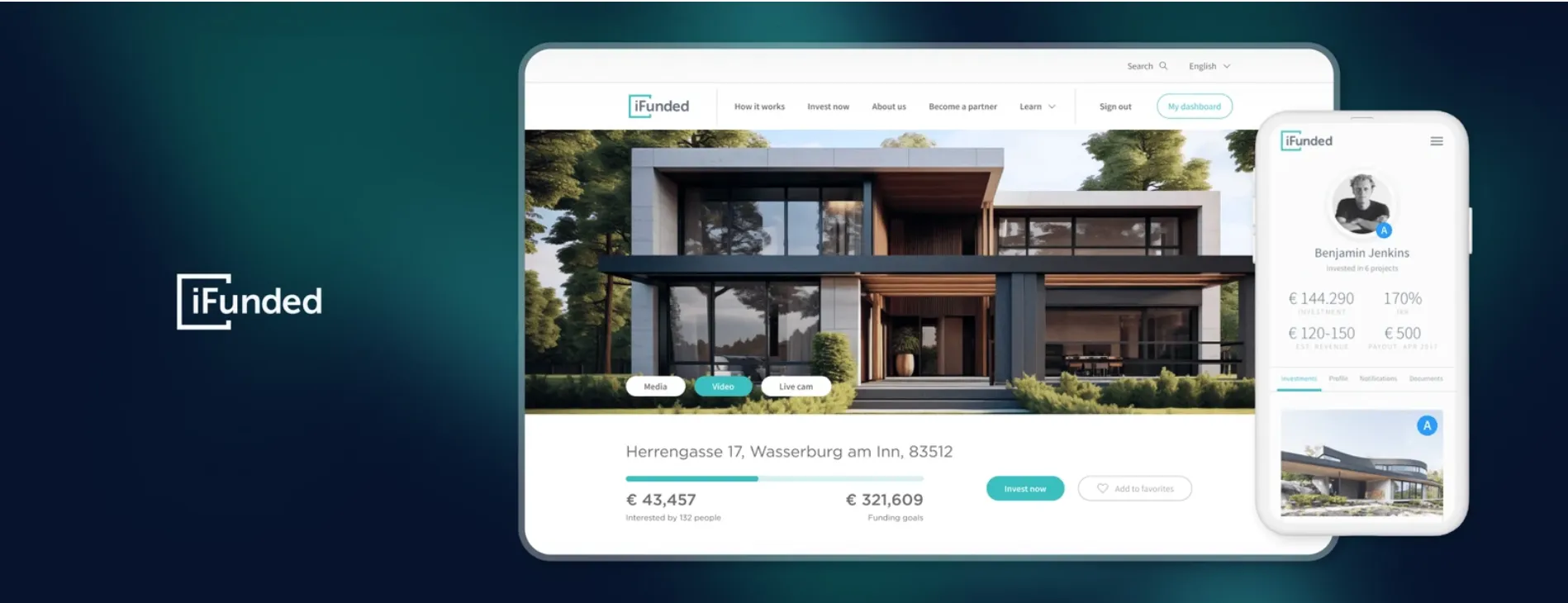
Institutional Investors Ghosting
iFunded powered €10M+ crowdfunding for Europe's serious B2B investors. Their design screamed "consumer scam" to compliance teams.
The numbers didn't lie:
- 18% KYC completion (82% abandoned at ID upload)
- 34% drop-off after first project view
- €250M AUM plateau while market grew 10x
- 6-18 month sales cycles (endless "prove you're legit" calls)
CFOs told sales: "This fails our vendor risk assessment."
Why Burn Millions on Bad Design
Every ghosted whale = €2.5M lost AUM. The cascade was brutal:
- Compliance teams killed deals pre-demo
- €1.2M wasted on marketing → low-quality leads
- Competitors stole 70% market share with boring-but-trustworthy design
- Board pressure mounted as growth stalled
iFunded faced a death spiral, beautiful design, zero institutional trust.
Trust-First Redesign
iFunded rebuilt from institutional trust outward. No fintech flash, just banking-grade signals everywhere.
1. Compliance Owned Every Screen
2. Enterprise Messaging Hierarchy
3. Live Transparency Dashboards
4. Human Backup Everywhere
5. CFO Microcopy
Implementation Framework: Deploy This Week
Day 1: Trust Audit
Score your top 3 acquisition screens (1-5 trust scale). Fix anything below 4.
Day 2-3: Build Trust Components
Create mandatory Figma components:
- Compliance badge kit
- Live metrics widgets
- Named human contacts
- Error recovery patterns
Day 4-5: Microcopy Rewrite
Replace all fintech jargon with executive clarity. Test 5 users.
Week 2: A/B Test
Run trust-enhanced variants vs. control. Expect 20-40% CR lift.
Ongoing: Trust Style Guide
Document patterns. Train marketing, support, sales. Consistency compounds.
Deadly Trust Mistakes Killing Your Acquisition
1. Footer-only compliance
Users never scroll that far. Hero section or nowhere.
2. Generic security claims
"Secure" = meaningless. "AES-256. SOC2 audited by Deloitte" = bulletproof.
3. Consumer design for B2B
Playful works for retail investing. Enterprises demand Deutsche Bank seriousness.
4. No human backup
"Contact support" kills 23% of flows. Named humans convert 19% better.
Final Thoughts
Your fintech moat isn't tech: it's trust. Competitors clone APIs overnight. They can't clone design consistency proving you're safe.
Pick one screen today:
- Pin compliance badges above fold
- Add named human backup
- Replace jargon with executive clarity
- Test with 5 real users
Trust compounds. Every reassured user today fuels tomorrow's referrals, deposits, and dominance.
FAQs
How fast does trust-first impact acquisition?
Week 1: 15-25% funnel lift. Month 3: 40%+ CR improvement.
Should B2B fintech look boring?
No—serious, not boring. Swiss banking precision meets modern clarity.
What if compliance kills creativity?
Good. Compliance is your moat. Display it proudly.
How do we measure trust ROI?
KYC completion, first-transaction rate, referral share rate, 90-day retention.



.svg)