15 min readMINUTES
We Studied 50 AI Startup Homepages. Here's What They Have in Common.

The short answer
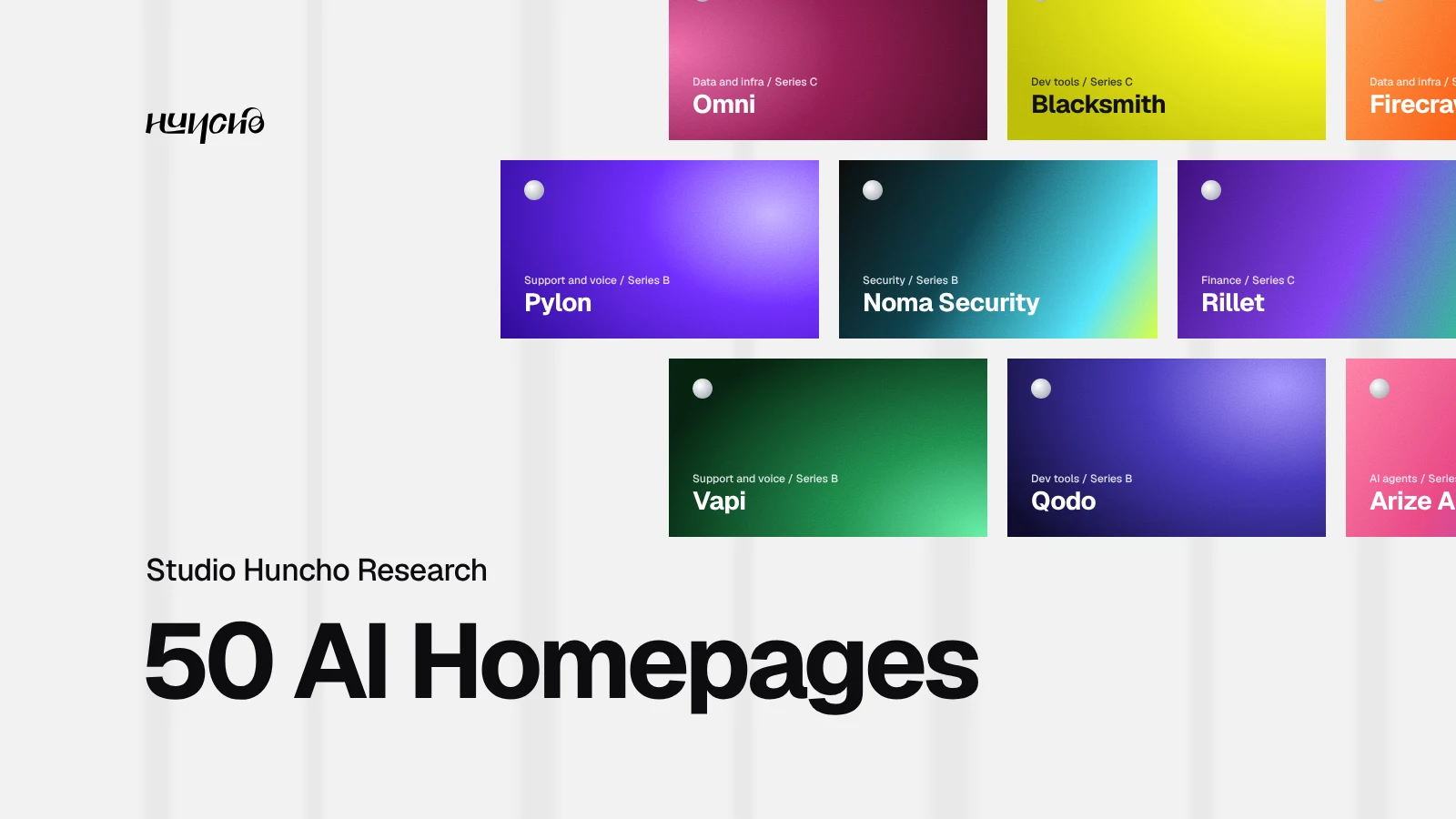
On 28 October 2026 we captured the homepages of 50 B2B AI startups that raised seed to Series C rounds between 2024 and 2026, then measured them the same way. Four things stood out. Half (52%) still lead with a demo button, but the split follows the buyer: every data and infrastructure company we looked at leads with self-serve, and every legal company leads with a demo. Only 36% show the real product in the hero, and the ones that do are mostly the self-serve ones (14 of 20, against 3 of 26 demo-led pages). Proof arrives early: 82% put a customer logo bar in the first two sections, and the median page uses four of the five proof types we tracked. And "agent" is the word of the year: 38% use agent, agents or agentic in the headline or subheadline, while none of the legal or finance companies does.
How we did it
Sample. 50 B2B AI startups across nine categories: AI agents, dev tools, sales and GTM, support and voice, healthcare operations, security (six each), data and infrastructure, finance (five each) and legal (four). Each has a publicly reported round announced between 2024 and 2026, from seed to Series C (one company's latest round is an unnamed growth round). The median latest round is $50M. 13 of the 50 are Y Combinator companies; lead investors include a16z, Sequoia, Accel, Index, Benchmark, Battery, ICONIQ, General Catalyst, Menlo and Khosla. We verified every round against a public source, listed in the appendix. We left out large late-stage companies, anything past Series C, and companies we work with, to keep the study neutral.
Selection. We started with 60 candidates. Three were ineligible: one had agreed to be acquired, one sells mainly to consumers, and one blocked our crawler. We removed seven more to balance the categories, favouring complete captures.
Capture. On 28 October 2026 a script loaded each homepage in Chromium at desktop size (1440x900) and mobile size (390x844), scrolled the full page so lazy content loaded, saved full-page screenshots and pulled data from the page: headline, subheadline, buttons, navigation, logos, quotes, fonts, word count and page height. A second pass loaded each page on its own with an empty cache to measure page weight, the load event and Largest Contentful Paint (LCP).
Hand review. Scripts are good at counting and bad at judgement, so we looked at every hero and the top of every page ourselves. We hand-coded the headline type, the primary call to action, the hero visual, whether a logo bar appears early, serif headlines and numeric proof, and corrected the script wherever it was wrong (cookie buttons read as CTAs, logos drawn in CSS, sample numbers inside product screenshots).
What we measured. Headline type and length, use of "agent", primary and secondary CTA, hero visual, dark or light hero, logo bars and logo counts, numeric proof, testimonials, case studies, security and compliance mentions, page height, sections, word count, navigation, pricing link, fonts, page weight and load timing.
Limitations. This is one snapshot on one day; homepages change often and some run A/B tests. "Latest round" means the latest we could find in public sources by 28 October 2026. Performance figures are lab numbers from a cloud server, one run per page, useful for comparing pages with each other but not the same as what your visitors experience. Testimonial counts rely on quotation marks plus our own checks, so they are a floor. Categories are our judgement and some groups are small (four to six companies), so the category cuts are directional. Nothing here proves that one pattern converts better than another; it shows what funded companies are doing.
Finding 1: 52% lead with a demo, and the category decides
26 of the 50 primary hero buttons ask for a demo or a sales conversation. 20 offer a free trial or sign-up. Four do something else, such as playing a video or starting a live voice demo. None asks visitors to join a waitlist.
The overall split hides a clear pattern by buyer:
- Data and infra (5): Demo-led 0; Self-serve-led 5; Other 0
- Sales and GTM (6): Demo-led 1; Self-serve-led 5; Other 0
- AI agents (6): Demo-led 2; Self-serve-led 3; Other 1
- Dev tools (6): Demo-led 4; Self-serve-led 2; Other 0
- Security (6): Demo-led 4; Self-serve-led 2; Other 0
- Support and voice (6): Demo-led 4; Self-serve-led 1; Other 1
- Healthcare ops (6): Demo-led 3; Self-serve-led 1; Other 2
- Finance (5): Demo-led 4; Self-serve-led 1; Other 0
- Legal (4): Demo-led 4; Self-serve-led 0; Other 0
Companies selling to developers and go-to-market teams let people start on their own: Daytona's hero says "Start for Free", Firecrawl's says "Start for free", Attio's filled button is "Start for free" next to "Talk to sales". Companies selling to lawyers, finance teams and health plans ask for a conversation: Spellbook, Supio, Rillet and Rogo all lead with a demo request.
30% of heroes offer both paths side by side, usually a self-serve button with a sales button next to it. Self-serve-led companies are also twice as likely to put Pricing in the nav (17 of 20, against 11 of 26 demo-led).
What it means for your homepage. Pick the button your buyer expects, not the one your peers use. If a developer can get value in ten minutes, make that the primary button and keep sales as the second. If the buyer needs procurement, security review or a pilot, lead with the demo and make it easy to book.
Finding 2: Only 36% show the real product in the hero
18 of 50 heroes show real product UI: a screenshot, a code sample or a working widget such as a search box or a live call demo. 15 use illustration, 3D or abstract art, 7 use photography or brand film, 7 are text only and 3 use a product video or animation.
Showing the product goes hand in hand with self-serve. 14 of the 20 self-serve-led homepages show the real product (70%). Only 3 of the 26 demo-led homepages do (12%); the most common demo-led hero is illustration or abstract art (11 of 26).
Some examples: Omni shows a chart answering a question typed in plain English, n8n and Firecrawl put a working input box in the hero, and Mem0 and Daytona show the code you would write. Five of the seven photography or brand-film heroes belong to legal and healthcare companies, such as Heidi and Anterior, which open with photography or film of people rather than software.
What it means for your homepage. If you want people to try the product, show it before they scroll. A clear, real screenshot does more than an abstract render, because the visitor can judge what they are signing up for. If you lead with a demo, the hero still has to answer "what does this look like?", even if the answer is one clean product view rather than the whole interface.
Finding 3: 82% put a logo bar in the first two sections
Proof arrives early and in layers:
- Numeric proof (customer counts, results, performance figures): 86%
- Customer logo bar in the first two sections: 82%
- At least one quoted testimonial: 78%
- Linked case studies or customer stories: 68%
- A named security or compliance standard: 52%
The median first logo bar shows 10 logos. The median homepage uses four of these five proof types, and 12 use all five. SOC 2 is the most cited standard (25 of 50), followed by GDPR (15) and HIPAA (14). Every legal company in the sample names at least one standard.
The numbers are specific: Rillet says it is used by 800+ customers in 70+ countries, Pylon says it is trusted by 1,500+ B2B customers, and Exaforce reports a 95% reduction in MTTI.
Healthcare is the exception on logos: only two of the six healthcare homepages show a logo bar near the top. Several lead with results or quotes instead.
What it means for your homepage. A logo bar under the hero is now table stakes for a funded company, so it will not set you apart on its own. What does is a specific number tied to a named customer, and a short case study a buyer can forward. If you sell to regulated teams, name your certifications on the homepage rather than leaving them on a security page.
Finding 4: 34% of headlines are category claims, and only 16% promise an outcome
We sorted every main headline into five types:
- Category claim: Share 34%; Examples "The AI analytics platform" (Omni), "The AI Code Reviewer" (Greptile)
- Abstract or brand line: Share 26%; Examples "Care reaches further" (Heidi), "Welcome to agentic revenue." (Attio)
- Product description: Share 24%; Examples "AI memory that persists across sessions and agents" (Mem0)
- Outcome or benefit: Share 16%; Examples "Zero-Day Close" (Rillet), "Month end shouldn't take all month" (Campfire)
- Question: Share 0%
The median headline is six words long. 28% of headlines are set in a serif, and more than half of those belong to finance, legal and healthcare companies.
Category claims make sense when the category is new and buyers search for it by name. The risk is that many companies in the same space claim similar categories, so the subheadline has to do the work of saying why you are different. Outcome headlines are rarer and tend to sit with companies whose result is easy to measure, such as a faster month-end close.
What it means for your homepage. Write the headline your buyer would repeat to a colleague. If your category is clear, claim it and use the subheadline for the proof point. If it is crowded, lead with the outcome you can actually stand behind, then name the category underneath.
Finding 5: 38% of heroes say "agent"
19 of 50 use agent, agents or agentic in the headline or subheadline, and 15 put it in the headline itself: "Voice agents for builders" (Vapi), "Outbound agents for every rep" (Unify), "Connect any agent to any user" (CopilotKit). In the AI agents category, four of six do.
None of the nine legal and finance companies uses the word in its hero. They talk about contracts, close and compliance instead.
A newer pattern sits next to the buttons. Five developer-facing homepages offer an action aimed at the buyer's own coding agent rather than the buyer: "Copy prompt" (CopilotKit), "Copy onboarding prompt" (Parallel), "Setup for Agent" (Mem0), "Connect Firecrawl" and Greptile's "onboard with your agent".
What it means for your homepage. Use "agent" if your buyer is shopping for agents. If your buyer is a general counsel or a controller, describe the work your product does in their language. If developers are your buyer, consider a set-up path their coding tools can follow.
Finding 6: The median homepage is 10 screens long on desktop and 14 on mobile
The median desktop page is 9,245px tall, about ten screens at 1440x900. On a 390px phone it is 11,646px, about 14 screens. The median page has 938 words of visible copy across about nine top-level sections, and a navigation bar with seven items. 58% have a Pricing link in the nav. None of the 49 pages we captured on mobile scrolled sideways.
Page length did not differ much between demo-led and self-serve-led companies (a median of 9,245px against 9,626px).
What it means for your homepage. Long is normal, so length alone is not a problem. The question is whether each section earns its place. Most visitors decide in the first two screens, which is why the hero, the first proof and the first product view matter more than section nine. Check the mobile version separately: at the median it is about four more screens of scrolling.
Finding 7: Half the pages weigh more than 5MB, and video is the main reason
The median page transferred 5.4MB after a full scroll and 2.8MB in the first five seconds after loading. 26 of 50 went over 5MB and 10 went over 10MB. 36% autoplay video somewhere on the page.
The hero choice shows up in the weight:
- Text only: 3.3MB
- Illustration, 3D or abstract: 3.4MB
- Real product UI: 6.0MB
- Photography or brand film: 11.7MB
- Product video or animation: 19.6MB (3 pages)
Lab load timing was mostly fine: median LCP was 1.6 seconds, and 22% of pages took longer than 2.5 seconds. Those are unthrottled lab numbers from a server, so real visitors on slower connections will see longer times.
What it means for your homepage. Film and motion can earn their place, especially when a product is hard to show. Compress video, load it after the first paint, serve smaller files to phones and give people a poster image while it loads. Check your page weight after a full scroll, not just at first load, because most of the weight arrives later.
Finding 8: 62% of heroes are light, and most companies use their own typefaces
19 of 50 heroes are dark. AI agent platforms are all light (none of six), while healthcare (four of six) and finance (three of five) lean dark.
Geist (8 sites) and Inter (6) are the most common font families, but 37 of the 50 use neither. Most companies use a licensed or custom typeface, and 56% use one family for both headlines and body copy.
What it means for your homepage. Dark or light is a brand choice more than a category rule, so choose the one that makes your product screenshots and proof easiest to read. A distinctive typeface is one of the cheapest ways to stop looking like the company next to you in a logo bar.
What this means for your homepage
- Match the primary button to your buyer. Self-serve if people can get value alone; demo if they need procurement, security review or a pilot. Offering both is fine; make one clearly primary.
- Show the real product above the fold, especially if you lead with a free trial.
- Put proof directly under the hero: logos, one specific number and a named customer quote.
- Link at least one case study a buyer can forward internally.
- Name your certifications (SOC 2, HIPAA, ISO 27001) on the homepage if you sell to regulated teams.
- Write a headline your buyer would repeat. Claim the category if it is clear; lead with the outcome if it is crowded.
- Use "agent" only if your buyer does.
- Check the page on a phone and after a full scroll: length, page weight and video behaviour.
- Add Pricing to the nav if you lead with self-serve.
Related reading: AI Company Website Design: What a B2B AI Homepage Needs, SaaS Website Design: 12 Best Practices With Real Examples, SaaS Landing Page Design: Anatomy of a Page That Converts, AI Website Examples: 25 AI Company Websites Worth Studying
FAQ
What should the main button on an AI startup's homepage say?
In our study of 50 funded B2B AI startups, 52% led with a demo or sales button and 40% with a free trial or sign-up. The choice followed the buyer: all five data and infrastructure companies led with self-serve, and all four legal companies led with a demo. Choose the path your buyer expects to take first.
Should an AI startup show its product in the hero?
36% of the homepages we studied show real product UI in the hero. It is far more common among self-serve companies (70% of them) than demo-led companies (12%). If you want visitors to sign up without talking to sales, showing the product helps them judge what they are signing up for.
How long is a typical AI startup homepage?
The median desktop homepage in our sample is 9,245px tall, about ten screens at 1440x900, with 938 words of visible copy and about nine sections. On a 390px-wide phone the median is 11,646px, about 14 screens.
Do AI startups still use customer logo bars?
Yes. 82% of the homepages we studied show a customer logo bar in the first two sections, with a median of 10 logos in the first bar. 86% also show numeric proof, 78% show at least one testimonial and 68% link to case studies.
How heavy are AI startup homepages?
The median homepage in our sample transferred 5.4MB after a full scroll. Half were over 5MB and one in five was over 10MB. Pages with photography or brand film in the hero were the heaviest group, at a median of 11.7MB.
Talk to us about your website
Studio Huncho is a creative studio in Bangalore that designs brands, websites and launch films for funded AI and B2B SaaS startups. If you are planning a new homepage or a redesign, talk to Studio Huncho about your website.
Appendix: the 50 companies
Latest round found in public sources as of 28 October 2026. Homepages captured on 28 October 2026.
- Arize AI (AI agents): Series C, $70M, led by Adams Street Partners, 2025-02-20. YC: No. Source: techcrunch.com
- CrewAI (AI agents): Seed + Series A, $18M, led by Insight Partners (Series A), 2024-10-22. YC: No. Source: siliconangle.com
- Gumloop (AI agents): Series B, $50M, led by Benchmark, 2026-03-12. YC: Yes. Source: techcrunch.com
- Maisa AI (AI agents): Seed, $25M, led by Creandum, 2025-08-27. YC: No. Source: techcrunch.com
- Relevance AI (AI agents): Series B, $24M, led by Bessemer Venture Partners, 2025-05-06. YC: No. Source: techcrunch.com
- n8n (AI agents): Series C, $180M, led by Accel, 2025-10-09. YC: No. Source: tech.eu
- Daytona (Data and infra): Series B, $60M, led by FirstMark Growth, 2026-10-23. YC: No. Source: techcrunch.com
- Firecrawl (Data and infra): Series B, $75M, led by Smash Capital, 2026-09. YC: Yes. Source: hedgeco.net
- Mem0 (Data and infra): Series A, $20M, led by Basis Set Ventures, 2025-10-28. YC: Yes. Source: techcrunch.com
- Omni (Data and infra): Series C, $120M, led by ICONIQ, 2026-04-23. YC: No. Source: siliconangle.com
- Parallel Web Systems (Data and infra): Series B, $100M, led by Sequoia, 2026-04-29. YC: No. Source: techcrunch.com
- Blacksmith (Dev tools): Series C, $66M, led by Sequoia, 2026-10-21. YC: Yes. Source: techcrunch.com
- CodeRabbit (Dev tools): Series C, $143M, led by Atomico and Smash Capital, 2026-08-12. YC: No. Source: raising.fi
- CopilotKit (Dev tools): Series A, $27M, led by Glilot Capital, NFX and SignalFire, 2026-05-05. YC: No. Source: techcrunch.com
- Greptile (Dev tools): Series B, $50M, led by Menlo Ventures, 2026-10-19. YC: Yes. Source: greptile.com
- Qodo (Dev tools): Series B, $70M, led by Qumra Capital, 2026-03-30. YC: No. Source: techcrunch.com
- Tessl (Dev tools): Seed + Series A, $125M, led by Index Ventures (Series A), 2024-11-14. YC: No. Source: techcrunch.com
- Campfire (Finance): Series B, $65M, led by Accel and Ribbit Capital, 2025-10-16. YC: Yes. Source: fintech.global
- Hebbia (Finance): Series B, $130M, led by Andreessen Horowitz, 2024-07-09. YC: No. Source: techcrunch.com
- Rillet (Finance): Series C, $100M, led by ICONIQ, 2026-08-19. YC: No. Source: techcrunch.com
- Rogo (Finance): Series C, $75M, led by Sequoia, 2026-01-28. YC: No. Source: fintech.global
- Sphere (Finance): Series A, $21M, led by Andreessen Horowitz, 2025-11-18. YC: Yes. Source: techcrunch.com
- Anterior (Healthcare ops): Growth round (unnamed), $40M, led by NEA and Sequoia, 2026-02-12. YC: No. Source: techfundingnews.com
- Assort Health (Healthcare ops): Series C, $120M, led by Menlo Ventures, 2026-06-24. YC: No. Source: healthcareittoday.com
- Heidi (Healthcare ops): Series C, $100M, led by Blackbird, 2026-09-23. YC: No. Source: itbrief.co.uk
- Hello Patient (Healthcare ops): Series A, $22.5M, led by Scale Venture Partners, 2025-09-05. YC: No. Source: medcitynews.com
- Taxo (Healthcare ops): Seed, $5M, led by Y Combinator, General Catalyst and Character Capital, 2025-03-28. YC: Yes. Source: techcrunch.com
- Triomics (Healthcare ops): Series B, $22M, led by Battery Ventures, 2026-05-27. YC: Yes. Source: techcrunch.com
- Definely (Legal): Series B, $30M, led by Not named in source (Revaia, Alumni Ventures, Beacon Capital), 2025-06-12. YC: No. Source: techcrunch.com
- Luminance (Legal): Series C, $75M, led by Point72 Private Investments, 2025-02-18. YC: No. Source: techcrunch.com
- Spellbook (Legal): Series B, $50M, led by Khosla Ventures, 2025-10-09. YC: No. Source: betakit.com
- Supio (Legal): Series B, $60M, led by Sapphire Ventures, 2025-04-30. YC: No. Source: techcrunch.com
- Attio (Sales and GTM): Series B, $52M, led by GV, 2025-08-27. YC: No. Source: builtinlondon.uk
- Landbase (Sales and GTM): Series A, $30M, led by Sound Ventures and Picus Capital, 2025-06-12. YC: No. Source: techcrunch.com
- Monaco (Sales and GTM): Series A, $25M, led by Founders Fund, 2026-02-11. YC: No. Source: techcrunch.com
- Peec AI (Sales and GTM): Series A, $21M, led by Singular, 2025-11-17. YC: No. Source: techcrunch.com
- The Prompting Company (Sales and GTM): Seed, $6.5M, led by Not named in source (Peak XV, Base10, YC), 2025-10-30. YC: Yes. Source: techcrunch.com
- Unify (Sales and GTM): Series B, $40M, led by Battery Ventures, 2025-07-15. YC: No. Source: unite.ai
- AegisAI (Security): Series A, $36M, led by Battery Ventures, 2026-07-23. YC: No. Source: techcrunch.com
- Aikido Security (Security): Series B, $60M, led by DST Global, 2026-01-14. YC: No. Source: securityweek.com
- Exaforce (Security): Series B, $125M, led by Not named in source (HarbourVest, Peak XV, Mayfield, Khosla), 2026-05-12. YC: No. Source: techcrunch.com
- HiddenLayer (Security): Series B, $100M, led by Delta-v Capital, 2026-09-02. YC: No. Source: techcrunch.com
- Noma Security (Security): Series B, $100M, led by Evolution Equity Partners, 2025-07-31. YC: No. Source: fintech.global
- Socket (Security): Series C, $60M, led by Thrive Capital, 2026-05-20. YC: No. Source: thesaasnews.com
- Bolna (Support and voice): Seed, $6.3M, led by General Catalyst, 2026-01-20. YC: Yes. Source: techcrunch.com
- Plain (Support and voice): Series A, $15M, led by Battery Ventures, 2025-02-14. YC: No. Source: techcrunch.com
- Pylon (Support and voice): Series B, $31M, led by a16z and Bain Capital Ventures, 2025-08-20. YC: Yes. Source: builtinsf.com
- Rime (Support and voice): Series A, $24M, led by M13, 2026-07-15. YC: No. Source: techcrunch.com
- Synthflow (Support and voice): Series A, $20M, led by Accel, 2025-06-25. YC: No. Source: synthflow.ai
- Vapi (Support and voice): Series B, $50M, led by Peak XV Partners, 2026-05-12. YC: Yes. Source: techcrunch.com
Work with Studio Huncho
We're a creative studio for AI and SaaS startups. We design brands, websites, products and launch films, and build sites in Webflow and Framer.