7 min readMINUTES
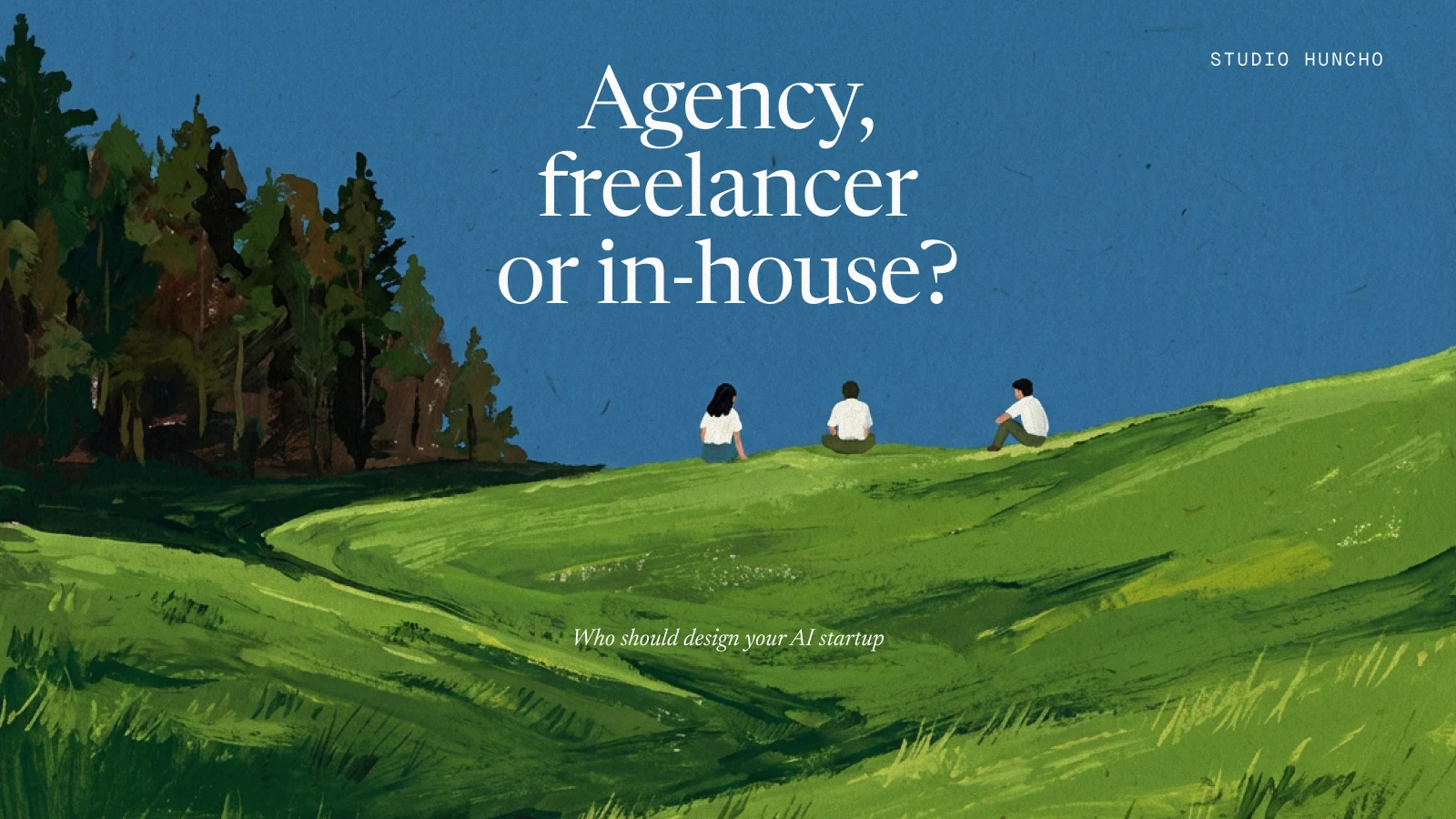
Agency vs Freelancer vs In-House Designer for AI Startups

The short answer
For AI startups between seed and Series B, the right choice depends on the work in front of you. A freelancer suits one well-defined job, such as a pitch deck or a landing page. An agency or studio suits brand, website and launch assets needed together, on a fixed date. An in-house designer suits steady, week-to-week work tied closely to the product. Many funded startups end up with a mix: a studio for the launch, then an in-house designer with the studio on retainer.
What you're choosing between
- Freelancer: one independent designer, hired per project or by the hour. Usually strong in one or two disciplines.
- Agency or studio: a team with a creative director, designers, developers and often motion specialists, hired per project or on retainer.
- In-house designer: a full-time employee who sits with your product and marketing teams.
None of these is better in general. Each is better at a particular stage and for a particular kind of work. Here is how they compare on the things founders tend to care about.
How they compare
Speed
A good freelancer can often start this week, which makes them the fastest option for a small job. An agency usually needs a short scoping and contract stage, then works in parallel: brand, web and motion can move at the same time because different people own them. That makes an agency faster for a full launch, even if it is slower to start. An in-house designer is the slowest to get going because you have to hire them first, but once settled they are the quickest for day-to-day requests.
Range of skills
AI startups rarely need just one kind of design. Before a raise or launch you might need a brand identity, a marketing website, product UI, a launch film and social assets, all in the same visual language.
- Freelancer: deep in one area, such as brand or product UI. For everything else you hire more freelancers and coordinate them yourself.
- Agency: covers brand, web, development, product and motion under one creative direction. This is the main reason startups hire one.
- In-house: one person rarely covers brand, web, product and motion at a high level. Most early in-house designers lean towards product.
Cost structure
Rates vary too much by market and seniority to be useful here, but the shape of the cost is different for each option:
- Freelancer: pay per project or per hour. The lowest commitment, with no ongoing cost once the work is done.
- Agency: a fixed fee per project or a monthly retainer. A higher cost per project, but it covers several disciplines plus project management.
- In-house: salary, equity, benefits, tools and recruiting costs. A fixed monthly cost whether there is a big project or not, which makes most sense once the work is steady.
Management overhead
This is the cost founders most often underestimate. With freelancers, someone on your team becomes the creative director and project manager: writing briefs, giving feedback and making sure three people's work looks like one company. An agency handles that internally, and you review and approve. An in-house designer needs managing too, along with feedback, a growth path and ideally a senior designer to learn from.
Continuity
An in-house designer builds deep knowledge of your product, users and roadmap, and that compounds over time. Freelancers come and go, and each new one has to learn your brand from scratch. Agencies sit in between: context stays with the team across projects, especially on a retainer, but they will never know your product the way an employee does.
Quality control
With a freelancer, quality rests on one person, and your own eye is the final check. An agency adds review layers, with a creative director and senior designers checking work before you see it. With an in-house designer, quality depends on their seniority and on whether anyone else in the company can give them strong design feedback. A junior designer working alone often struggles without that support.
Hiring time
Freelancers and agencies can usually start within days or weeks. Hiring a strong full-time designer means sourcing, portfolio reviews, interviews, a design exercise and a notice period, which commonly runs to months. If your launch date is fixed, that gap matters.
When each makes sense
A freelancer makes sense when
- The job is small and clearly defined: a pitch deck, a landing page, a set of illustrations.
- Someone on your team can brief and direct the work.
- You already have a brand system for them to follow.
An agency or studio makes sense when
- You need a brand identity, a website and launch assets together, in one visual language.
- A fundraise, launch or rebrand has a fixed date.
- No one on the team has the time or experience to act as creative director.
For example, we did the brand, website, motion and Webflow build for Further AI in the window before its raise, and Refold AI's rebrand and new website went live in 45 days.
An in-house designer makes sense when
- Design work is steady every week, mostly in the product.
- Your core brand is in place and you need someone to apply and extend it.
- You can give the designer real ownership and someone experienced to learn from.
The common hybrid
A pattern we see often with funded AI startups works in three stages:
- Studio for the launch. A studio builds the brand identity, website and launch film around a raise or launch, when speed and range matter most.
- In-house designer after it. Once the system exists, a full-time designer owns product UI and day-to-day marketing work, applying the brand rather than inventing it.
- Studio on retainer. The studio stays on for the bigger or more specialised pieces: launch films, campaign motion, new site sections, 3D or a brand refresh.
This gives you speed when it counts and continuity afterwards. It also makes the in-house hire easier, because a designer who joins with a clear brand system can be useful from the first week. Pine Labs works with us in a similar way for motion design, from announcement films to event work.
A simple checklist
- List what you need in the next six months: brand, website, product, motion.
- Mark which items have a fixed date.
- Decide who on your team will direct the design work, and how many hours a week they really have.
- If it's one discipline and you have someone to direct it, start with a freelancer.
- If it's several disciplines on a deadline, start with a studio.
- If design work is steady and mostly product, start the in-house search now, because it takes time.
FAQ
Is an agency worth it for a seed-stage startup?
It can be, if the work is tied to a raise or launch and needs several disciplines at once. If you only need a landing page and a deck, a good freelancer is usually enough.
When should an AI startup hire its first in-house designer?
When design work becomes constant rather than project-based, usually once the product team is growing and the core brand exists. Hiring before the brand is in place often leaves one person trying to do everything.
Can a freelancer handle brand and website together?
Some can, especially for a small site. For a full identity, a custom website build and motion, most founders end up hiring several people or a studio.
How long does a studio take compared with hiring in-house?
A studio can usually start within weeks. At Studio Huncho, brand projects usually take 4 to 6 weeks and most websites 2 to 6 weeks. Hiring a senior designer can take longer than that before they even start.
Can we use a studio and an in-house designer at the same time?
Yes, that's the hybrid above. The in-house designer handles product and daily work, and the studio handles launches and specialist work such as launch films and motion.
Not sure which setup fits your next six months? Tell us what's coming up and we'll give you a straight answer, even if it's "hire a freelancer".
Work with Studio Huncho
We're a creative studio for AI and SaaS startups. We design brands, websites, products and launch films, and build sites in Webflow and Framer.