13 min readMINUTES
We Studied 290 YC AI Startup Websites. Here's What They're Built With.

The short answer
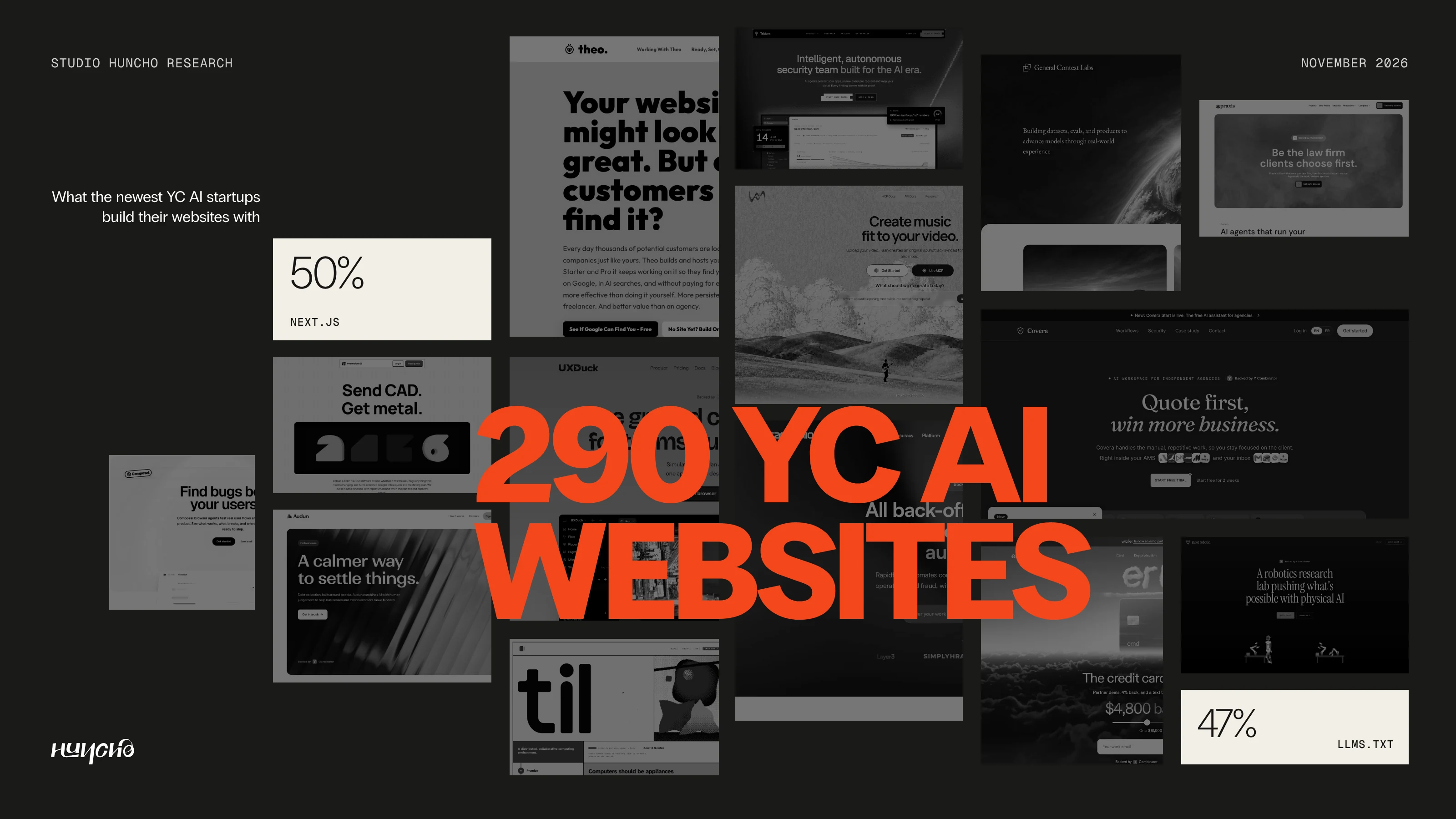
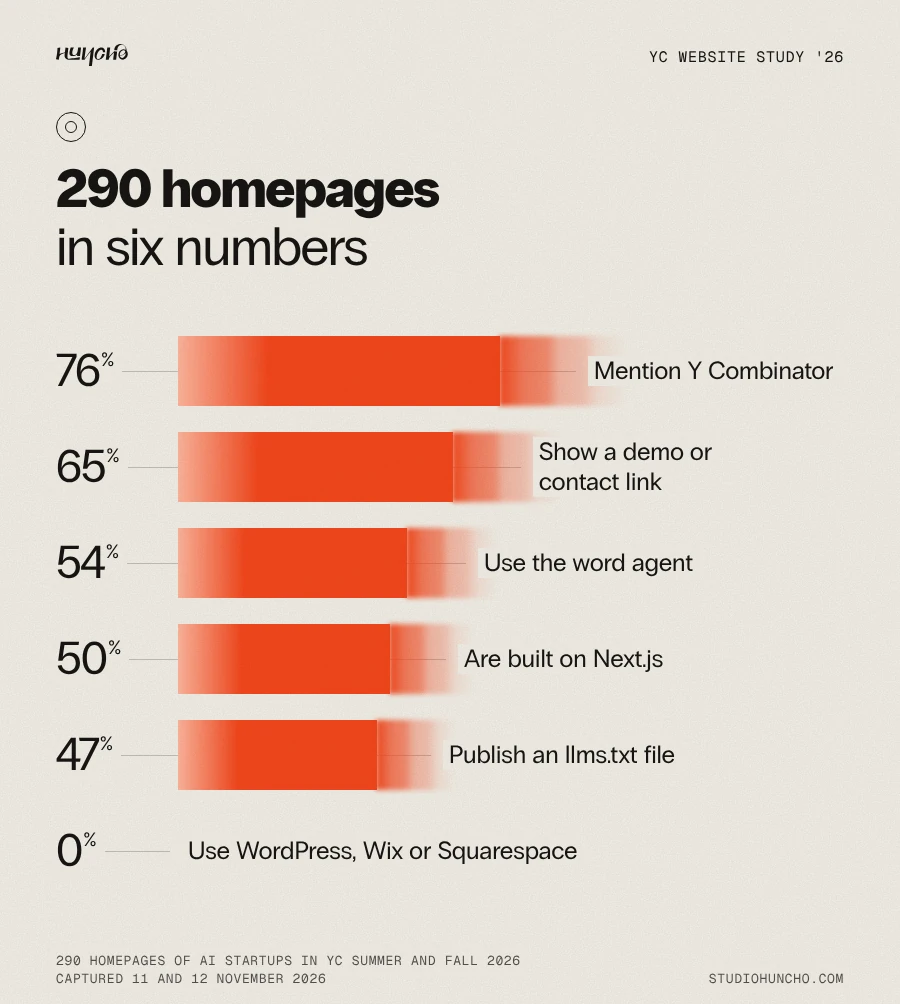
On 11 and 12 November 2026 we loaded the homepage of every active, AI-tagged company in Y Combinator's Summer 2026 and Fall 2026 batches that lists a website. That is 301 companies, and 290 of the pages loaded. Four things stood out. Half of them (145) are built on Next.js, 15 (5%) use Framer or Webflow, and not one runs on WordPress, Wix or Squarespace. One in six (50) uses no framework at all, only plain HTML, CSS and JavaScript files. Almost half (137, or 47%) already publish an llms.txt file for AI assistants. And the first screen sells a conversation: 65% show a demo or contact link, 30% show a way to start alone, and 76% of homepages mention Y Combinator.
How we did it
Sample. We used the open mirror of Y Combinator's public company directory (the yc-oss project), as updated on 11 November 2026. The Summer 2026 and Fall 2026 batches list 453 companies. 301 of them are active, carry a tag containing "AI" (AI, Generative AI or AI Assistant) and list a website. 11 did not load for us (timeouts, blocked requests or empty pages), which leaves 290 homepages: 148 from Summer 2026 and 142 from Fall 2026. These are very young companies. The median team size listed is two people. By YC's own industry label the sample is 175 B2B, 48 Industrials, 23 Fintech, 19 Consumer, 16 Healthcare and 9 others.
Capture. A script opened each homepage in Chromium at 1440x900, waited about five seconds and recorded what it found: framework and site-builder signatures in the page source, the hosting headers, the headline, every link and button visible on the first screen, fonts, page height, bytes transferred, and whether /llms.txt returns a real text file. It also saved a screenshot of the first screen. We ran two passes, on 11 and 12 November.
Hand checks. Scripts count well and judge badly, so we checked the parts that needed judgement.
- Unclassified sites. The script could not name the platform for 64 sites. We read their source files one by one: 14 were Vite, Astro, Jekyll or TanStack builds, and 50 had no framework signature at all.
- llms.txt. We requested every file again on 12 November. Each one we had counted was a real markdown file, not an error page.
- Dark or light. We measured this from the screenshot pixels and looked at the 14 borderline pages by eye.
- Buttons. We compared the script's labels with 40 random screenshots. The "demo or contact link" label matched what we saw on 40 of 40 pages and the "self-serve link" label on 37 of 40. We also tried to make the script pick the single main button. It agreed with us on only 30 of 39 pages, so we do not report a main-button figure.
Limitations. This is one snapshot of companies that are a few months old, and many of these sites will be rebuilt within a year. Directory tags are chosen by the founders. Platform signatures can miss a site that sits behind a proxy or uses an unusual build. The Cloudflare figure counts sites served through Cloudflare's network, which can sit in front of another host. Page weight is the data transferred in the first five seconds without scrolling, measured once from a cloud server, so read it as a floor. It is not comparable with our study of 50 funded AI startup homepages, which measured weight after a full scroll. "First screen" means a 1440x900 desktop window. Nothing here shows that one choice converts better than another. It shows what this group of founders chose.
Finding 1: Half are built on Next.js, and none on WordPress
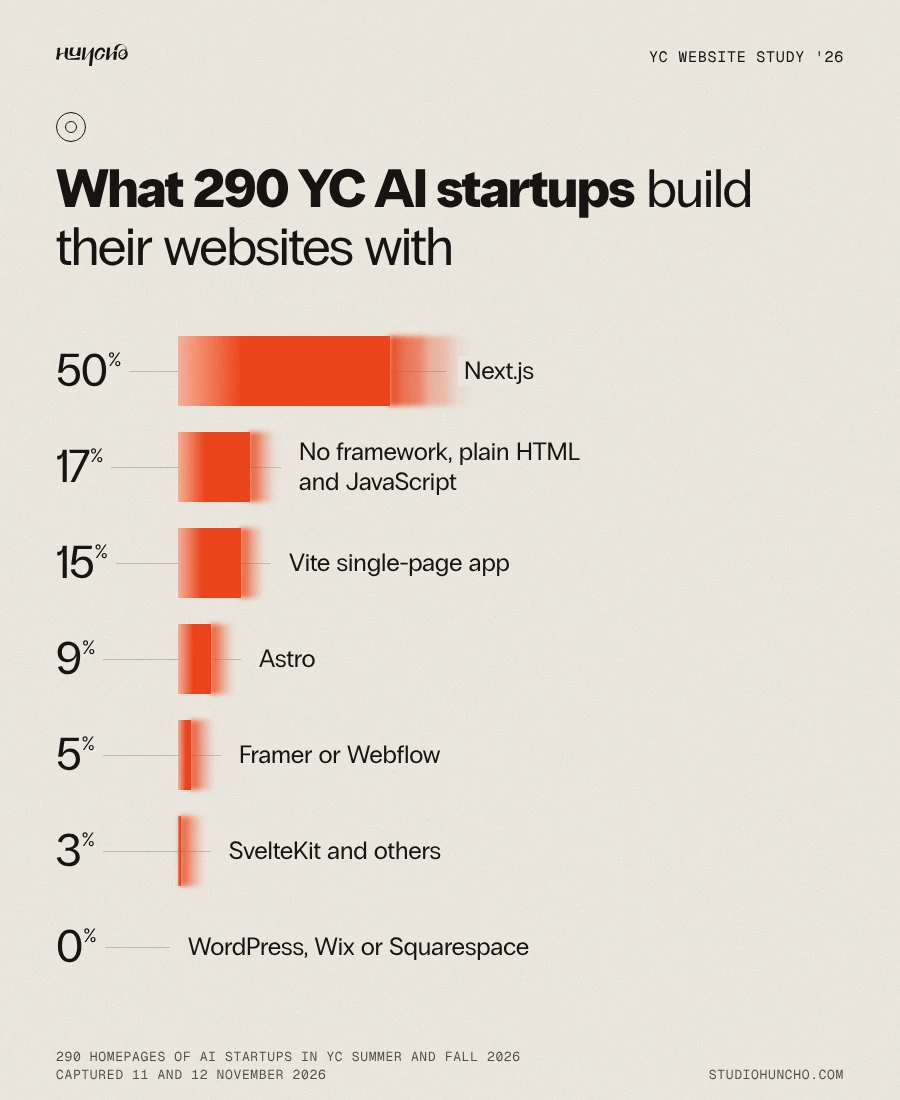
145 of the 290 homepages (50%) are Next.js sites. Here is the full split:
- Next.js: 145 (50%)
- No framework detected: 50 (17%)
- Vite single-page app: 43 (15%)
- Astro: 27 (9%)
- Framer: 8 (3%)
- Webflow: 7 (2%)
- SvelteKit: 6 (2%)
- Other (Jekyll, Lovable, Remix and TanStack Start, one each): 4 (1%)
- WordPress, Wix, Squarespace: 0
Hosting follows the same pattern. 138 sites (48%) are served by Vercel and 107 (37%) through Cloudflare. Of the 145 Next.js sites, 102 (70%) are on Vercel.
The reason is not hard to see. With a median team of two, the people writing the product are also writing the website, and they reach for the stack they already use. A site builder would be one more tool to learn in a week when there is a product to ship.
What it means for your website. At this stage, building the site in your product stack is a sensible default and nobody will judge you for it. The cost shows up later. Once someone outside engineering needs to publish a page, change a headline or add a case study every week, a site that lives in the product repository becomes a queue. We build on Webflow and Framer, so read that with our bias in mind: in our experience the move to a site that marketing can edit usually happens around the first proper funding round, not before it.
Finding 2: One in six ships plain HTML with no framework
50 of the 290 homepages (17%) carry no framework signature. They are hand-named files such as site.js, app.js and main.js, often with a version number on the end, served as static pages. 28 of the 50 are served through Cloudflare.
They are also the lightest group. The median plain site transferred 1.3 MB on first load, against 2.6 MB for the median Next.js site. And they cluster in hardware: 17 of the 48 Industrials companies (35%) ship a plain site, against 23 of the 175 B2B companies (13%).
We cannot tell from the outside how each of these pages was written, so we will not guess. What we can say is that a static page with a headline, a short explanation and a contact button is a deliberate choice for a company whose buyers will never sign up online.
What it means for your website. If your site only has to say what you build and who to call, you do not need a framework. Spend the time on the headline and the one image that explains the product.
Finding 3: 47% already publish an llms.txt file
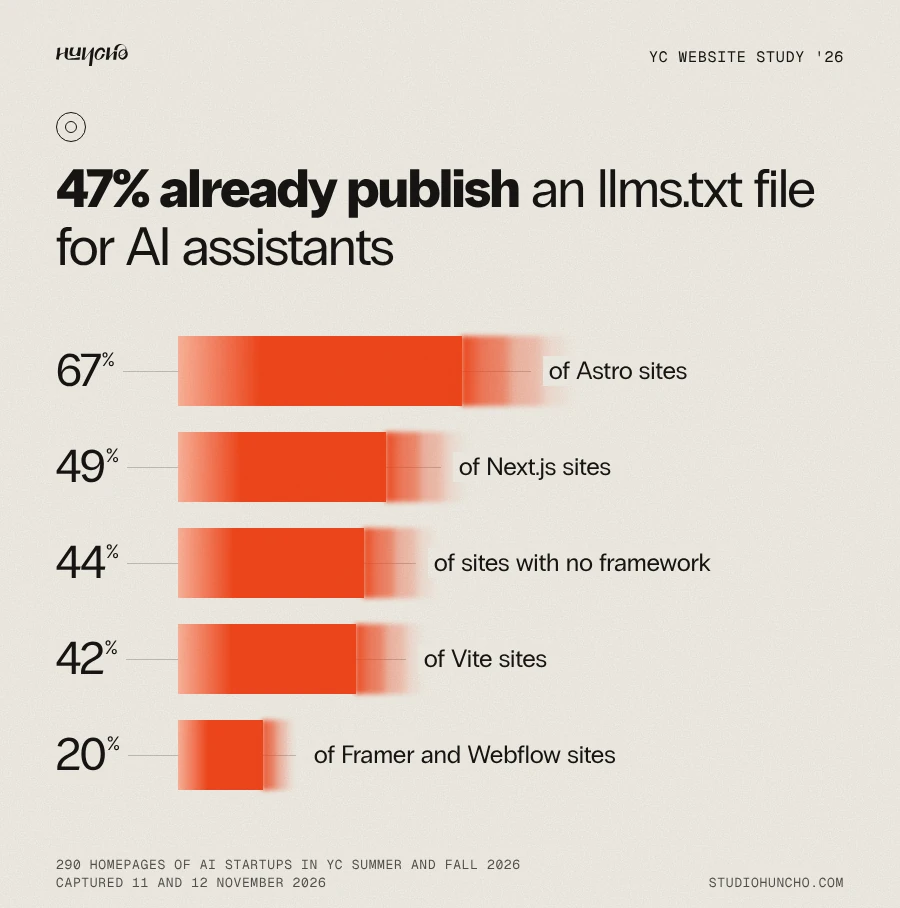
137 of the 290 sites (47%) return a real llms.txt file. llms.txt is a proposed plain-text file at the root of a site that tells AI assistants what the site contains and where the important pages are. It is a proposal, not a standard, and there is no guarantee that an assistant reads it.
These founders publish it anyway. By platform, the share is highest on Astro (18 of 27, or 67%), then Next.js (71 of 145, 49%), plain HTML (22 of 50, 44%) and Vite (18 of 43, 42%). Only 3 of the 15 Framer and Webflow sites have one. By industry, 51% of B2B companies have the file against 31% of Industrials.
The basics are close to universal: 99% of the homepages have a meta description and 87% have a social share image. 4% have no H1 heading at all.
What it means for your website. Founders who build AI products treat AI assistants as readers of their site. The file takes an hour to write, so there is little reason to skip it. It does not replace clear pages that answer real questions, which is still what gets a company named in an AI answer.
Finding 4: 65% show a demo or contact link on the first screen, and 30% a way to start alone
We sorted every link and button visible on the first screen into types.
- Demo or contact (book a demo, talk to us, get in touch, request a quote): 189 sites (65%)
- Self-serve (sign up, get started, try it, get an API key): 88 sites (30%)
- Both on the same screen: 55 sites (19%)
- Demo or contact only: 134 sites (46%)
- Self-serve only: 33 sites (11%)
- Waitlist, early access or reservation: 25 sites (9%)
- Download or install command: 22 sites (8%)
- None of these: 44 sites (15%)
The buyer decides the button. Among the 175 B2B companies, 71% show a demo or contact link and 41% a self-serve link. Among the 48 Industrials companies, 69% show a demo or contact link and only 6% offer self-serve. Consumer companies do neither much (2 of 19 show a demo link). They are more likely to offer a waitlist (6 of 19) or a download (5 of 19).
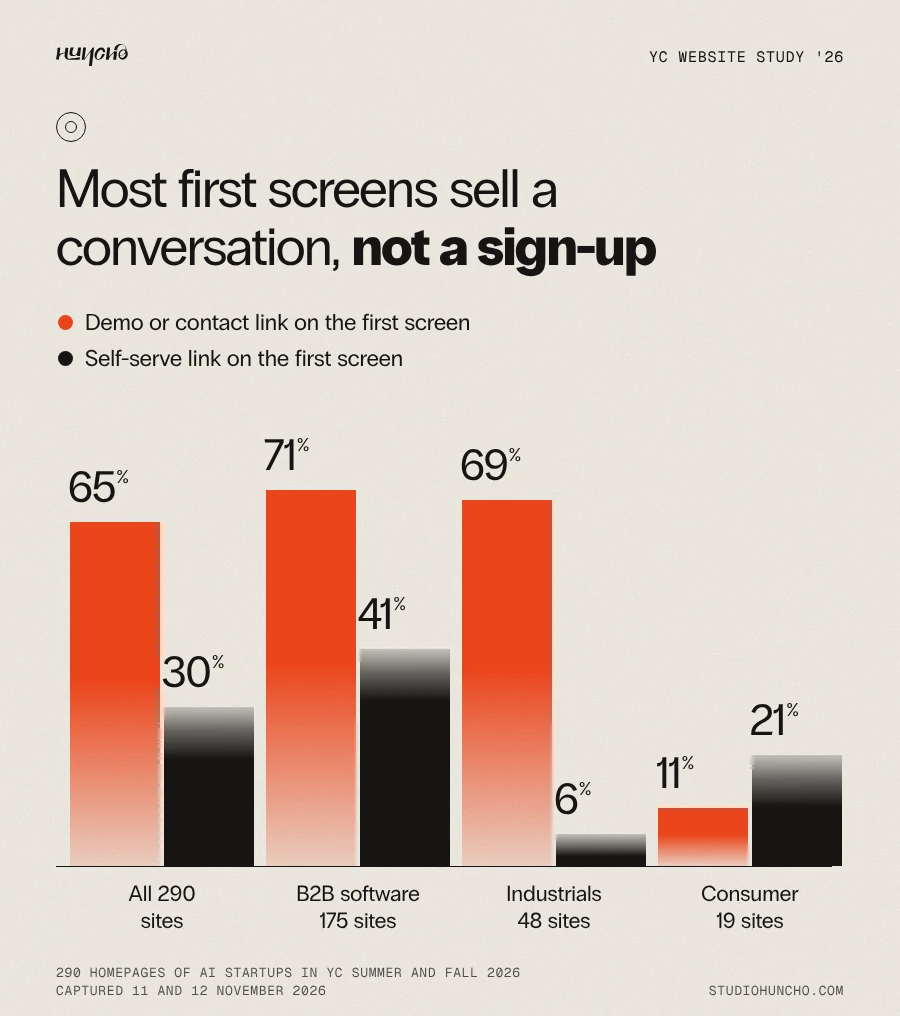
Some examples from the screenshots: Rex and Collar each show a single demo button, Resin leads with "Try Resin for free", Summer Engine offers a macOS download, and jcode puts an install command where the button would be. 23 sites (8%) put a text field on the first screen, split about evenly between a work email box and a prompt box where you type what you want the product to do.
Pricing follows the button. 76 sites (26%) have Pricing in the navigation. Among sites with a self-serve link it is 52 of 88 (59%); among demo-only sites it is 12 of 134 (9%). And 63 sites (22%) link straight to a scheduling tool such as Cal.com or Calendly from the homepage.
What it means for your website. Decide which of the two you are before you design the hero. If a stranger can get value alone, give them the start button and show Pricing. If the product needs a pilot, a contract or hardware, a clear demo button with a calendar behind it is the honest version. Offering both is fine as long as one is clearly the main one.
Finding 5: 76% mention Y Combinator, and most do it on the first screen
219 of the 290 homepages (76%) mention or link to Y Combinator somewhere. At least 170 (59%) do it on the first screen, usually as a "Backed by Y Combinator" badge next to the headline. That 59% is a floor: in our hand check the script missed two badges that were images with no text.
It makes sense. A company with two people and a handful of pilots has few customer logos to show, so the badge is the proof. Compare that with the funded companies in our earlier study, where 82% put a customer logo bar in the first two sections.
What it means for your website. Borrowed credibility is fine when it is all you have. Plan what replaces it: the first three customer logos, one number a buyer cares about and one named quote. The badge can move to the footer the day those exist.
Finding 6: 54% say "agent", and 18% put it in the headline
158 of the 290 homepages (54%) use agent, agents or agentic somewhere on the page. 51 (18%) use it in the main headline, and 72 (25%) have "AI" in the headline.
It is a software word. 117 of the 175 B2B companies (67%) use it, against 13 of the 48 Industrials companies (27%) and 5 of the 16 Healthcare companies.
Headlines are short. The median H1 is six words, and a quarter are four words or fewer.
What it means for your website. When two thirds of B2B AI homepages say "agent", the word no longer tells a buyer what makes you different. Use it if your buyer uses it, then spend the rest of the headline on the job it does and who it does it for.
Finding 7: 60% are light, 40% are dark, and Inter and Geist do most of the typing
Of the 282 first screens we have screenshots for, 169 (60%) are light and 113 (40%) are dark. Industrials companies lean dark (58%), B2B companies lean light (33% dark).
Type is less varied than it looks. Inter sets the body text on 64 sites (22%) and Geist on 43 (15%), so more than a third of the sample reads in one of two typefaces. For headlines, Inter leads with 41 sites (14%) and Geist follows with 34 (12%), then Instrument Sans (11) and DM Sans (8). 42 sites (14%) set the headline in a serif, most often Instrument Serif, Fraunces or Newsreader. In total we counted 124 different headline typefaces.
What it means for your website. Default fonts are a fine place to start and a poor place to stay. If your page is light, set in Inter or Geist and says "agent", that description also fits 37 other homepages in this sample. One distinctive typeface and one colour of your own is the cheapest way out of that group. Our guide to AI company website design covers the rest.
Finding 8: The median homepage is seven screens long and 2.5 MB on first load
The median page is 6,560 pixels tall when it loads, about seven screens at 1440x900. A quarter are shorter than 4,300 pixels and a quarter are longer than 9,200. 18 sites (6%) are a single screen with no scroll at all. The median page shows 557 words.
The median homepage transferred 2.5 MB in the first five seconds, before any scrolling. 19% came in under 1 MB, 23% went over 5 MB and 10% over 10 MB. Video is the main cause: the 69 pages (24%) that play a video on the first screen have a median of 5.8 MB, against 2.0 MB for the rest.
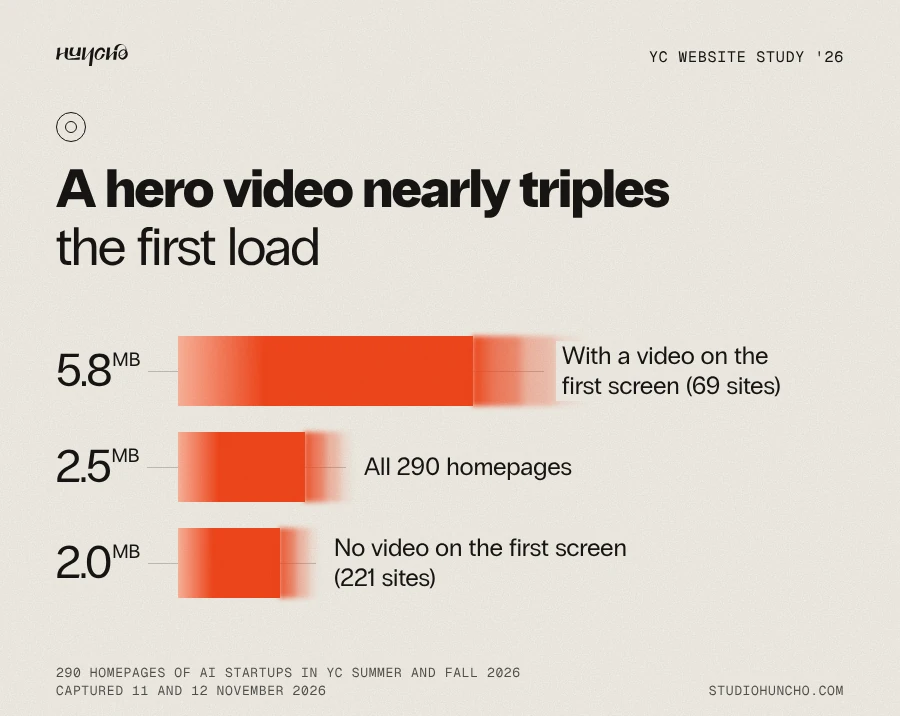
For analytics, we detected PostHog on 24% of sites and Google Analytics or Tag Manager on 26%.
What it means for your website. Seven screens is enough room for a hero, the problem, the product, proof and a call to action, which matches what we recommend in what should be on a B2B SaaS homepage. If you use video in the hero, compress it and load a poster image first, because that one file can double the weight of the page.
What this means for your website
- Build in your product stack while you are two people. Plan the move to a site marketing can edit for when someone outside engineering needs to publish.
- A plain static page is enough if the site only has to explain the product and start a conversation.
- Add an llms.txt file. Almost half of this sample already has one.
- Choose demo or self-serve on purpose, and put Pricing in the navigation if you choose self-serve.
- Use the YC badge now and plan its replacement: customer logos, one number and one named quote.
- Treat "agent" as a category word, not a headline. Say what the product does and for whom.
- Pick one typeface and one colour that are yours. Light, Inter or Geist and "agent" describes 37 homepages in this sample.
- Watch the hero video. It is the difference between a 2 MB page and a 6 MB page.
Related reading: We studied 50 AI startup homepages · Design for YC startups · AI website examples · What is llms.txt?
FAQ
What do YC startups build their websites with?
In our November 2026 study of 290 AI startups from Y Combinator's Summer and Fall 2026 batches, 50% of homepages were built on Next.js, 17% used plain HTML with no framework, 15% were Vite single-page apps and 9% used Astro. Framer and Webflow together made up 5%, and none used WordPress, Wix or Squarespace.
Do YC startups use Webflow or Framer?
A few do at batch stage. 8 of the 290 homepages we studied were on Framer and 7 on Webflow. Most founders at this stage build the site in the same stack as the product. In our experience the move to a site builder usually comes later, when a marketing team needs to edit the site without engineers.
How many startups have an llms.txt file?
137 of the 290 YC AI startup sites we checked (47%) had a real llms.txt file in November 2026. The share was highest on Astro sites (67%) and lowest on Framer and Webflow sites (3 of 15).
Should an early-stage startup lead with a demo or a free trial?
It depends on the buyer. 65% of the homepages we studied show a demo or contact link on the first screen and 30% show a self-serve link. B2B software companies offered self-serve far more often (41%) than hardware and industrial companies (6%). If a stranger can get value alone, lead with self-serve. If the product needs a pilot or a contract, lead with the demo.
Should a startup put "Backed by Y Combinator" on its homepage?
Most do. 76% of the homepages we studied mention Y Combinator and at least 59% show it on the first screen. It works as proof while a company has few customers to name. Replace it with customer logos and results as soon as you have them.
How long and how heavy is a typical early-stage startup homepage?
The median homepage in our sample was about seven screens tall on desktop, showed 557 words and transferred 2.5 MB on first load. Pages with a video on the first screen had a median of 5.8 MB.
Talk to us about your website
Studio Huncho is a creative studio in Bangalore that designs brands, websites and launch films for funded AI and B2B SaaS startups, from seed stage to IPO. If your batch-stage site has done its job and you are planning the next one, tell us what you are building.
Appendix: the 290 companies
Company names as listed in the directory on 11 November 2026. Homepages captured on 11 and 12 November 2026.
Summer 2026 (148): 83 Sciences, Agnost AI, Akon Labs, Allia Health, Alloovium, Almanac, Amorphic Labs, Arbital, Archal, Assemble, Async, Atlia, Audun, Baud, Bernard, Billow AI Labs, Bizmark, Bloomy, Callbook AI, Care GP, CarSignal, Click, COACH, CoArena, Computable, Conifer, Context.dev, Cova, Daqstra, Datoric, Dawn Industries, Decawork, DeepReach Inc., Denta, Dipole Labs, Dock, Donkey, Dream, Egoist Machines, Ekho Labs, Elite, Enact, Erinys, Evergrove, Executor, Exosat, Fabraix, Financial Datasets, Florin, Frontier Computing, Gamgee, General Context Labs, GitCafe, Glen, Grocalo, GUILD, hardware intelligence, Hebbian Robotics, Hoplite, HyperProbe, Illume Labs, IMPACT Drones, Induction Labs, Inkbox, Insurf, Isengard Industries Inc, Jcode, Kebra, Lamb Labs, LATO, LemonLime, Libra Robotics, Litmus, Locke, Luca IQ, Lumeria, Magma, Marble, Marengo, Marker, Mireye, Mochi, Mosaic, Most Robotic, Moving Atoms, MusicArena, NebuSec, Neuromorphic, Olam Labs, Omanta, OneCLI, OneTriangle, Ooak Data, OpenRelay, OpenTag, Orchestra, OS3, Osseus, Pacific, Palette, Palisade, Palisade, Pango, Parasma, Pennant, Perceptron ML, Petrarch, Pluto, Poth Labs, PRINCEPS, Prodigy Research, Proprio Robotics, Qlo, Rapidfolio, Rasyn, Rational, RealPact, rekursiv.ai, Rex, Rindler, Robocurve, screenpipe, Shiraz AI, Sidekick, Skymerse, Snowstone, Speko, Standard Machines, Stoa, Studio, Synapse Semiconductor, Tenor, Tokenless, Torus, Touchmark, TovenAI, Traceforce, Tracer, Trident, Trope, Tsenta, Verdant, Verdict Machine, Waddle Labs, Waybill, Whitespace, Zaplar, Zomma.
Fall 2026 (142): Adalat AI, Agent 37, Agent Relay, Ageospatial, Aikido Technologies, Ailit, Alkera AI, Altair Health, Ample Computer, antimattr, Applied Kinetics, Archgen Labs, Armorer Labs, Aucert, Audora, Axiomat, Bayworks, Blinka, Boxes.dev, ByteAsk, Caveman, Cesara, ChampionEffect Inc., ClaimKit, Collar, Composal, Confetti, Constor, CONUS, Covera, Cyclon, Databuddy, Decent, Definite, Dreamscale Labs, Dydema, Elithia, Epsilab, ernd, Evardi, Evident Machines, Faraday, Fleety, Forward, Frontrunner, GodHands, Gradon, Graphide, Grep AI, Helios Intelligence, herdr, Hesper AI, HillStar, Hopper, Hue, HyperBench, Ignition Benefits, InfraOptimal, Invertix, isoquant, Kiwi, Lantern AI, Lark, Latent, Liquid Energy, Melty, Metalcraft, Mirrors, Munito AI, Native, OpenCrawl, OpenHack, OpenLake Technologies, OpenScaffold, OpEra, Ordo Labs, Organizely, Orgo, ORO AI, Papaya, Perceptual Labs, Petrichor, Phone Harness, Plek AI, Ploid, Plover Labs, Polemos Industries, Pomerado, Praxis, Preload, Primordiant, Proto, Quivly AI, Raven, Reconero, Redoubt Insurance, Reific, Resin Technologies, Rezora IO, RightNow, Risklytics, River, Rodeo Robotics, Roma, Routant, RouterPlus, Runtime.si, Rystic, SE3 Labs, Sentient OS, Shepherd Robotics, Simantic, Simulithic, Sintropix, Sona8, Spacesheep, Stacktrace, Summer Engine, Superserve, Taan.ai, Talos, Telamont, Terse, The Agentic Data Co., Theo, Tilo, Topos, Trepo, twentyfour26, UXDuck, Veeza AI, Verdun, Verno, Versine, Vexo, Viraj Aero, Volaren, Vorelios, Vorflux, Wingman Law, Wondersearch, Yam.
Work with Studio Huncho
We're a creative studio for AI and SaaS startups. We design brands, websites, products and launch films, and build sites in Webflow and Framer.