5 min readMINUTES
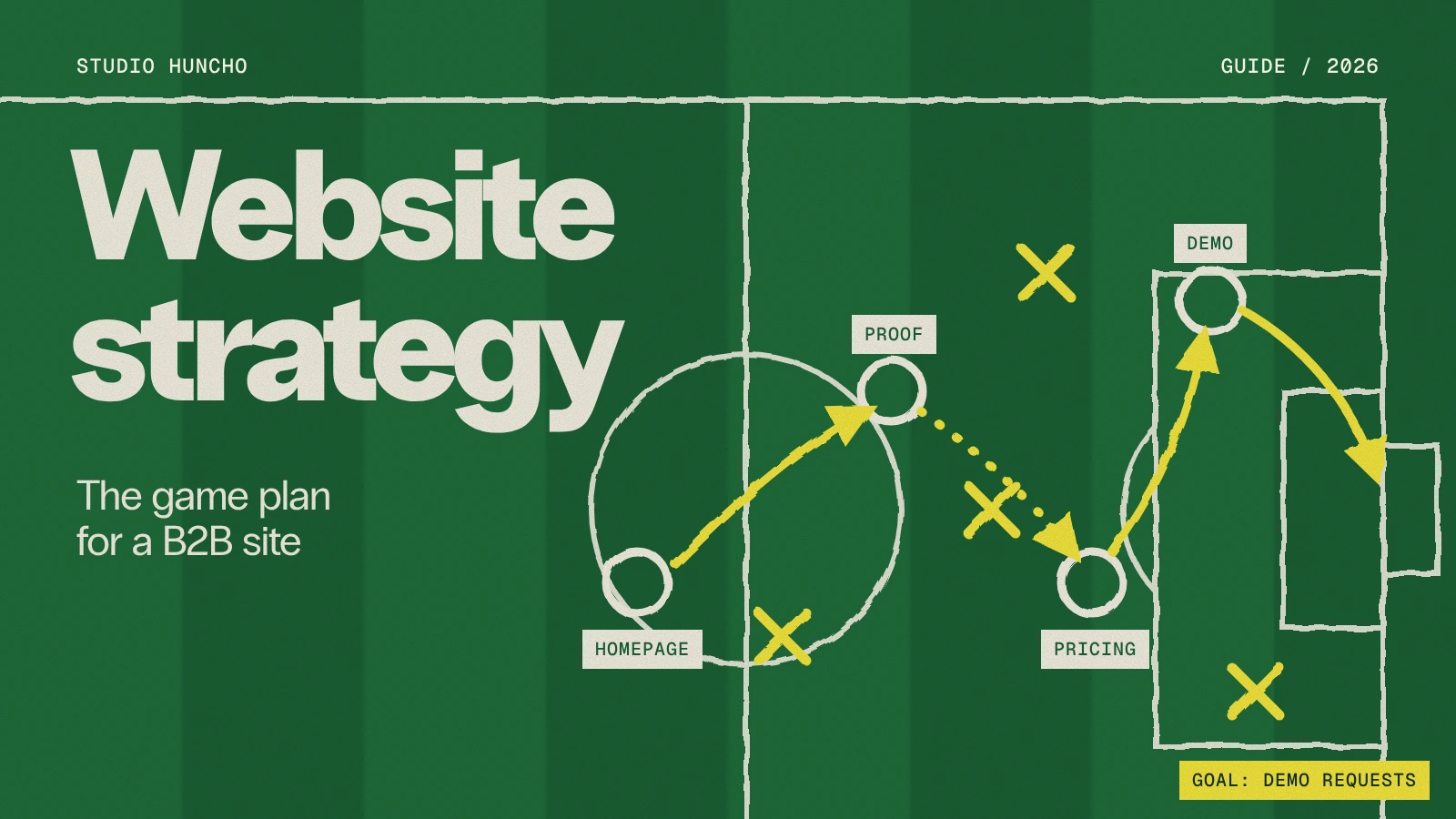
Website Strategy: A Practical Guide for B2B Startups (2026)

The short answer
A website strategy is a short written plan that says what the site is for, who it serves, what it must say, which pages it needs and how success will be measured. It should fit on one page and be agreed before design starts. Most weak startup websites are not badly designed. They were designed without one.
What a website strategy is, and is not
It is the link between a business goal and the pages on the site. It is not a sitemap on its own, a set of brand guidelines or a list of SEO keywords, though it produces all three.
- It starts from the business. What has to happen this year: pipeline, sign-ups, hiring or a funding announcement.
- It names the reader. Two or three types of buyer, and what each needs to see before acting.
- It ends in decisions. Which pages exist, what each one says and what the main button does.
The eight parts of a website strategy
1. One primary goal
Pick one: demo requests, self-serve sign-ups, investor credibility or hiring. Secondary goals are fine, but one has to win when they conflict, because it decides the headline, the navigation and the main button.
2. The audience
List the two or three people who visit and decide. For a B2B product this is often a user, a budget holder and a technical or security reviewer. Write down the one question each of them arrives with.
3. The message
One sentence that says what the product does and for whom, in words a buyer would use. In our study of 50 funded AI startup homepages, 38% used "agent", "agents" or "agentic" in the headline or subheadline. A word that common no longer sets a company apart, so the message has to say what the product actually does.
4. Proof
Decide what evidence you can show and where: customer logos, case studies with numbers, security certifications, investors. In the same study, 82% of homepages put a customer logo bar in the first two sections. Buyers look for proof before they read features.
5. Structure
The sitemap follows from the audience and the proof. A seed startup may need five pages. A Series B company selling to several industries needs product, solution, customer and resource sections. See what pages a startup website needs.
6. The conversion path
Match the main button to how people buy. Self-serve products lead with a free start, and products that need setup or a contract lead with a demo. Among the 290 Y Combinator AI startup websites we studied, 65% showed a demo or contact link on the first screen and 30% showed a self-serve link. More on this in book a demo or start free.
7. Search and AI visibility
List the questions buyers type into Google and ask AI assistants, and plan a page that answers each one. Add structured data, keep company facts consistent, and make sure crawlers can read the pages. 47% of the Y Combinator AI startup sites in our study already publish an llms.txt file. Our guide to getting recommended by ChatGPT covers the rest.
8. Measurement
Choose two or three numbers before launch, such as demo requests, sign-ups and organic visits to product pages. Record the baseline. Without one, nobody can say whether the new site worked.
A one-page website strategy template
Copy these prompts into a document and answer each in one or two lines.
- Goal: the one result the site must produce in the next 12 months.
- Readers: who visits, and the question each arrives with.
- Message: what we do, for whom, and why us, in one sentence.
- Proof: the logos, numbers, stories and certifications we can show.
- Pages: the list of pages and templates, in priority order.
- Main action: the one button, and what happens after the click.
- Questions to own: the searches and AI questions we want to be the answer to.
- Metrics: two or three numbers, with today's baseline.
- Owner: who runs the site after launch.
How the strategy changes by stage
- Seed. The job is credibility. A clear homepage, a product page, a short about page and a way to get in touch. Investors, first customers and candidates all read the same five pages.
- Series A. The job is pipeline. Product and use case pages, customer stories, and a demo path that sales can rely on.
- Series B and later. The job is scale. Pages per industry and segment, a resource library, careers, and a CMS that several people can publish to.
- Selling to enterprises. Add security, compliance and integration pages, and plan for review by more people. See what enterprise web design involves.
The platform is part of the strategy
Who will run the site decides where it should be built. In our study of 290 Y Combinator AI startup websites, half ran on Next.js and only about 5% on Framer or Webflow. Engineers build what they know. That works while engineers have time for the marketing site, and it stops working when marketing needs to publish every week. We build in Webflow and Framer, so we have a bias here, and the question is still worth asking plainly: who will edit this site in a year? See Next.js or Webflow for a startup website.
Common mistakes
- Starting with visuals. Moodboards before the message is agreed.
- Writing for yourself. Internal product names and features instead of the buyer's problem.
- Too many goals. A homepage that tries to sell, hire, announce and educate at once.
- Copying a competitor's sitemap. Their structure answers their buyers, not yours.
- No owner after launch. A site with no editor is out of date within months.
- Measuring nothing. No baseline, so no way to judge the result.
How long it takes
For a startup, the strategy is days of work, not months, provided the people who decide are in the room. It is the first step of a website project at Studio Huncho: the sitemap, the pages and the content plan are agreed before design starts. Most websites we make then ship in 2 to 6 weeks. See startup website design, B2B website design and the website redesign process, week by week.
FAQ
What is a website strategy?
A short written plan that sets the site's goal, audience, message, proof, pages, main action and metrics, agreed before design starts.
How is website strategy different from SEO strategy?
SEO strategy is one part of it. Website strategy also covers the message, the structure, the conversion path and who runs the site.
Who should write it?
The person who owns the site, usually the head of marketing or a founder, with input from sales and product. A studio can run the process, but the answers have to come from the company.
How often should it be updated?
Review it when the company changes: a new round, a new product, a new market or a move upmarket.
Do small startups need one?
Yes, and theirs is the shortest. One page is enough for a five-page site.
Planning a new website? Tell us about it and we reply with a scoping doc and timeline within 48 hours.
Work with Studio Huncho
We're a creative studio for AI and SaaS startups. We design brands, websites, products and launch videos, and build sites in Webflow and Framer.